“The more that you read, the more things you know. The more that you learn, the more places you’ll go!” Dr Seuss. 
AIMS
Our aim is to empower children to acquire, demonstrate, articulate and value the knowledge and skills that will support them as life-long learners and competent communicators. English is for everyone. We foster a passion for reading and writing: quality texts are used to inspire and promote the love of reading and writing throughout the school. We recognise that the precise acquisition of language skills forms firm foundations; children leave our school with secure English skills that allow them to thrive and become life-long learners in a multitude of subjects. Our children are encouraged to express themselves and reinforce their opinions with thoughtful, reasoned arguments: speaking and listening skills are carefully crafted and include public speaking, debating, and drama activities to assist in the development of vocabulary. Our school values all aspects of writing and we aim to make children proud of their written work in all areas of the curriculum through engaging stimuli!
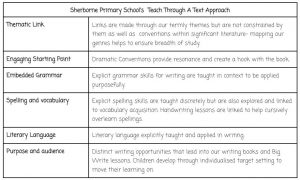
METHODOLOGY
By placing books at the core, we are allowing teachers to use the text as the context for the requirements of the national curriculum. The national curriculum states that:
‘‘This guidance is not intended to constrain or restrict teachers’ creativity, simply to provide the structure on which they can construct exciting lessons.’
This would suggest that a context for learning is vital – and this is where our chosen approach can support teachers with ensuring that objectives for reading and writing, including those for grammar can have purpose.
We will always aim for our writing opportunities to be meaningful; whether short or long and that the audience is clear. Books offer this opportunity: our final aim would be that children have real reasons to write, whether to explain, persuade, inform or instruct and that where possible, this can be embedded within text or linked to a curriculum area. Writing in role using a range of genres is key to our approach as is writing a critique of the text and making comparisons – all writing skills that will support children in preparation for their time in secondary school. This sits comfortably alongside the following statement from the English national curriculum:
‘The national curriculum for English aims to ensure that all pupils write clearly, accurately and coherently, adapting their language and style in and for a range of contexts, purposes and audiences.’
In many cases National Curriculum objectives are covered more than once and children have opportunities to apply these several times over the course of a year, as well as to consolidate prior knowledge from previous years. We believe strongly that children should be secure in applying the skills of curriculum 2014 within their writing and their reading and that this approach is fully comprehensive. Where needed, planning sequences are adapted, personalised and differentiated by the school to ensure all access arrangements can be made to support children with the requirements.
Key documents
Handwriting and Presentation Policy (Draft)
Writing At Expected Standard EYFS to Year 6
English Genre Progression and Development Overview
Reading / Phonics
You can access the library system here: Libresoft Librarian
Your child’s reading experience is much more than the reading book which comes home from school. Reading is happening all the time. We teach it in specific reading and English lessons, but children are practising and using their ‘reading’ constantly across all other subjects too.
You can support this ‘reading journey’ through regular reading at home. Reading to and with your child every evening for at least ten minutes can make a dramatic difference to your child’s achievement within school.
Six tips for reading with your child at home:
1. Make time to read- even ten minutes a day
2. Choose different types of books
3. Take turns to read
4. Talk about the book- asking your child questions
5. Pay attention to the language
6. Enjoy reading
Reading Scheme
Children will start their reading journey at Sherborne Primary School following the Ruth Miskin Read Write Inc phonics programme. Please see our Phonics page for more information.
We base learning to read primarily on this programme. Currently when children move beyond this we are using the Oxford Reading Tree books until your child may be ready to enjoy ‘Accerlerated Reader’ as explained below, meaning that they can choose from our class and library ranges suitable to their age and ability.
Children will also have access to our mini libraries situated outside of Grasshoppers Class and within their own classrooms. These books are for sharing to foster a love of reading with you as the challenge will be too great for independent reading.
Accelerated Reader
Accelerated Reader, a Renaissance Learning product, allows children to make consistent progress in their reading throughout KS2. The scheme motivates children by matching them with a book that stretches their skills, but without causing frustration. Children take a quiz after completing the book, and gradually move up through the levels. Teachers are able to set manageable targets within the scheme, to give students something to strive for. Our library contains an incredible wealth of books, so there is something for everyone!
Children at Sherborne Primary School will start this scheme in Year 2 when they are ready and it will run until the end of Year 6.
Phonics
At Sherborne Primary School we have introduced the highly successful Ruth Miskin Read Write Inc phonics programme starting from September 2020 to teach our children to read, write and spell. Our aim is to ensure that our children become competent at spelling and fluent at reading, giving them the best possible start to their learning journey.
Read Write Inc sessions take place each day for all Reception and Year 1 children. The pace and consistency of the programme is a key element to developing reading skills which unlocks the whole curriculum for our children.
The ultimate aim of the Read Write Inc programme is for children to be able to learn and apply sound blending skills and to learn to segment words in order to become confident and fluent readers.
In Reception, the children have daily speed sound and blending lessons building up to reading storybooks exactly matched to the sounds they have learnt.
In Year 1 the Read Write Inc lesson involves a 20 minute speed sound practice and 20 minutes of guided reading. We will incorporate all this work into well structured class writing sessions that complement our phonic work.
In Year 2 children will complete their Phonics journey and move on to our school Accelerated Reader Programme as well as well our spelling programme, which will continue until Year 6.
In Years 3-4 children who require phonics catch-up will have the opportunity.
All children who are reading the RWI storybooks in their class lessons will bring these ‘Teaching Books’ home as well as a Book Bag Book which exactly matches the sounds learnt in the session. The children will be able to read these books independently but it is important that you listen to your child read these books several times so that they build up their fluency and expression. In addition to these books they will bring home a library book of their choice which will be above their reading level therefore it is important that you share the reading of this book with your child.
“I don’t think there’s a big secret about what to do; we need to show children how much we love stories. Read great stories, poems and non-fiction every day, all through school. What we love today they might read tomorrow.” Ruth Miskin
Please click the link below to find more helpful information for parents
https://www.ruthmiskin.com/en/find-out-more/parents/
Useful Links
Foundational Handwriting at Sherborne Primary
Introduction to Read Write Inc
Phonics and Read Write Inc Vocabulary
10 things to think about when you read to your child
10 things your child learns when you read stories and poems everyday
Helping your child with reading
Ideas of story books to read at home
Set 1 Sounds: Parent Meeting Handout
Set_2_and_3_Sounds Parents Meeting Handout
ReadWriteInc_Letter Information Rhymes
Achieving – Belonging – Caring
In this section